Measuring guilt and shame in adolescents
This research was completed in collaboration with a Ana Radanović, Milica Damnjanović, Svetlana Pavlović, Ljiljana Mihić, and Ksenija Krstić.
According to some researchers, shame and guilt are not the same thing. Both are so-called self-conscious emotions (as is, for example, pride) and both are moral emotions as they are felt when we compare our behavior to some standard. The term shame is used to describe the feeling we experience when we attribute a (moral) failure on our part to our stable uncontrollable characteristics (e.g., “I am a bad person”). In turn, the emotion of guilt is experienced when the person applies a negative evaluation to the specific action (e.g., “What I did is bad”), thus differentiating between themselves as a person and the particular action, blaming some unstable personal characteristics. The consequences of experiencing these emotions are often different as well. With shame, we may rather wish to hide and disappear (after all, nothing can be done about how awful we are!), while feeling guilt may lead to the more adaptive attempts to correct the mistake and make amends, that is, fix the unstable personal characteristics that created the problem in the first place.
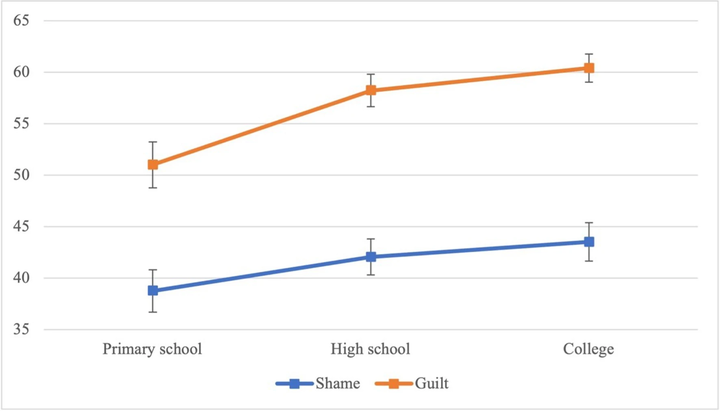
If we wish to relate feelings of shame and guilt to other important psychological variables like personal well-being, we need to know whether a person experiences shame and guilt and to what extent. For that, we need good instruments to measure these emotions. One such instrument is the Test of Self-Conscious Affect (TOSCA), which has a version called TOSCA-A designed specifically for adolescents. We tested whether TOSCA-A works well in the Serbian language. To achieve that, we first needed to translate and adapt TOSCA-A. Then, we administered the adapted version to three adolescent groups: primary school students aged 13 to 15, high school students aged 14 to 19, and university students aged 18 to 20. The main objective of the work was to see whether TOSCA-A works as expected in Serbian. The shortest answer: it does. The separation between shame and guilt is observed and the two distinct self-conscious emotions are correlated with other psychological variables as one might expect. However, it also seems that the instrument does not behave exactly equally across the three age groups, and not just in the sense of the differences in the amount of shame and guilt experienced by these three groups (shown in the graph above). It seems that the three groups do not approach the test in the same way. There may be differences in the structure of these emotions across developmental stages. Additionally, some particular questions (scenarios) may need further adaptation to particular age groups. You can read more about this project and what we think may be exciting future work regarding these issues in our published paper.